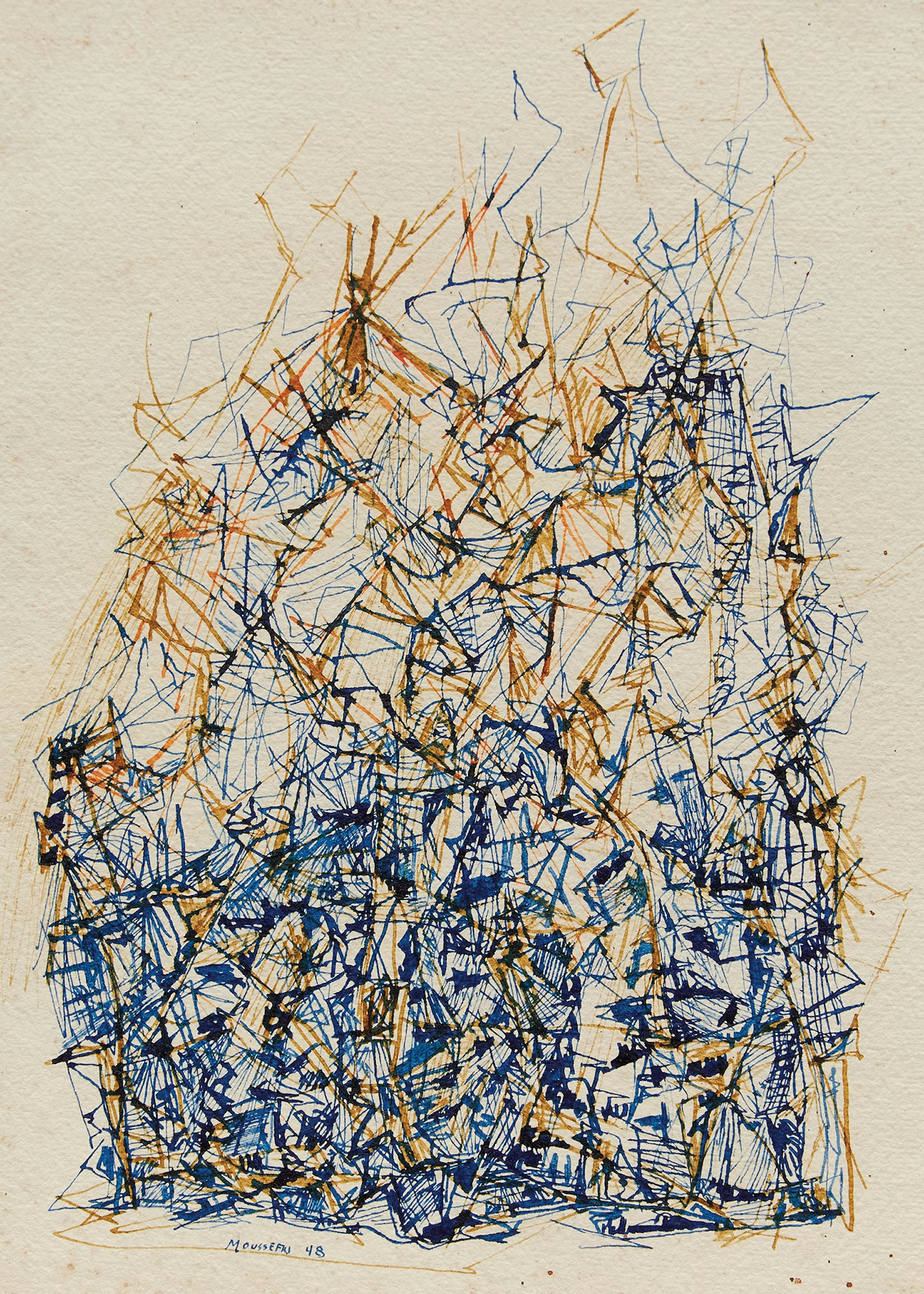
Paul-Émile Borduas, author of the manifesto Refus global (1948), used the term plastic reality for the material truth behind a painting:
The plastic reality, the only reality of the work, remains hidden under a mass of illusions: woman, chair, smile, dress, etc.; unknown, untouched, unseen either in detail or in totality. — Paul-Émile Borduas, "Qu'est-ce que l'automatisme?" in L'Autorité, 29 May 1954.
Borduas built a taxonomy to distinguish how different practices relate to this plastic layer. Mechanical automatism (dripping, folding) produces universal plastic qualities governed by physical laws, qualities that belong to the process and carry only generic traces of whoever initiated it. Psychic automatism, which he identified in the painting of Salvador Dalí and Yves Tanguy, works through remembered dreams and hallucinations arranged into imagery. Because memory is involved, Borduas wrote, attention drifts toward the depicted subject and away from the material surface. His own contribution, surrational automatism, is unpremeditated writing in plastic matter, where one shape calls up another with "complete moral independence" toward the result. He cited Isidore Ducasse (Lautréamont), author of Maldoror: form is inevitably linked to content. The hand adjusting to the resistance of charcoal on paper produces plastic content that belongs to one person's sensibility in one encounter with one material.
The painter's song is a vibration imprinted on matter by a human sensibility. Through it, matter is made to live. — Paul-Émile Borduas, in conversations with Maurice Gagnon
Borduas insisted the work be produced "in a constant state of becoming so that instinct may express itself continuously." The plastic layer emerges from friction between a particular hand and a particular material. Oil resists the turn of the wrist, and the painter's response carries the full weight of a body's accumulated history.
Fernand Leduc, a co-signatory of Refus global, wrote:
Imagination liberated by automatism... can finally submit to its own transformational power in order to organize a totally new world of forms, conceived outside of any figurative, anecdotal or symbolic reminiscence. — Fernand Leduc, "Vers les îles de Lumière"
Every passage of the brush deposits weight, texture, rhythm into matter, and the surface holds that deposit as what Borduas called plastic reality: the only reality of the work, hidden beneath the illusions of subject and symbol, accessible only through the act itself.
Today, a large language model trains on hundreds of billions of words, adjusting numerical weights until it can predict which token most likely follows any given sequence. A language model draws from the full statistical weight of its corpus to generate the woman, the chair, the smile, the dress, reassembled from compressed patterns. Borduas's illusion layer is all a language model can produce, because the illusion layer is all it can record.
Borduas called Dalí's method psychic automatism: recalled hallucinations organized the canvas, and attention drifted toward the depicted subject as memory mediated between impulse and surface. A language model's training corpus functions as an equivalent memory, compressed from millions of prior human acts, with every output organized by recalled patterns. The language model intensifies the problem Borduas diagnosed in psychic automatism: the output is illusion layer the whole way through, reconstituted from statistical weights, surface assembled from a compressed archive.
Surrational automatism worked because the painter stood in front of a surface and made marks whose plastic consequences were immediately present as matter. One shape called up another because the first shape had edges the eye and hand could register and respond to. Borduas's "constant state of becoming" describes a loop between a nervous system and a material surface, running at the speed of muscular response. Without this reference point, we lose the only reliable distinction between generation and retrieval. A language model produces sequences that look like becoming but contain no underlying surface; no moment where something already real refuses the gesture and forces a different one. If the concept of plastic reality disappears from the vocabulary, there is no longer a word for what the machine cannot do.